You've probably heard the pitch: AI agents will run your business, eliminate toil, and maybe even send your emails. You may have seen a demo doing all of this. The agent plans, reasons, executes, and delivers. It's exciting potential — we can have huge success with the power of AI for our business!
Then it hits production.
Suddenly the LLM times out. A critical API has a brief outage. Two agents make conflicting changes to the same record. Nobody knows what the agent actually did. The CFO wants to know why the LLM bill tripled overnight. And the team that owns the billing agent and the team that owns the inventory agent are both sure the bug is in the other team's code.
This is the gap between "agentic AI" and "agentic AI you'd actually trust with your business." Bridging that gap — an architecture you'd run your business on — is exactly what Temporal was built for. And it turns out, for agents, it matters more than ever.
As an Architect at Temporal, I've helped customers who have run into these problems. I've done shiny agentic demos. But I've also helped customers build out agentic platforms that power their business — and I wanted to share my perspective and experience on why Temporal is a critical enabler for agentic platforms.
The many shapes of an agent#
Before we talk about orchestration, let me be specific about what is being built. "Agents" is a big umbrella. I've worked on these four big patterns in this space. While they have some shared architecture needs, they also have meaningfully different requirements.
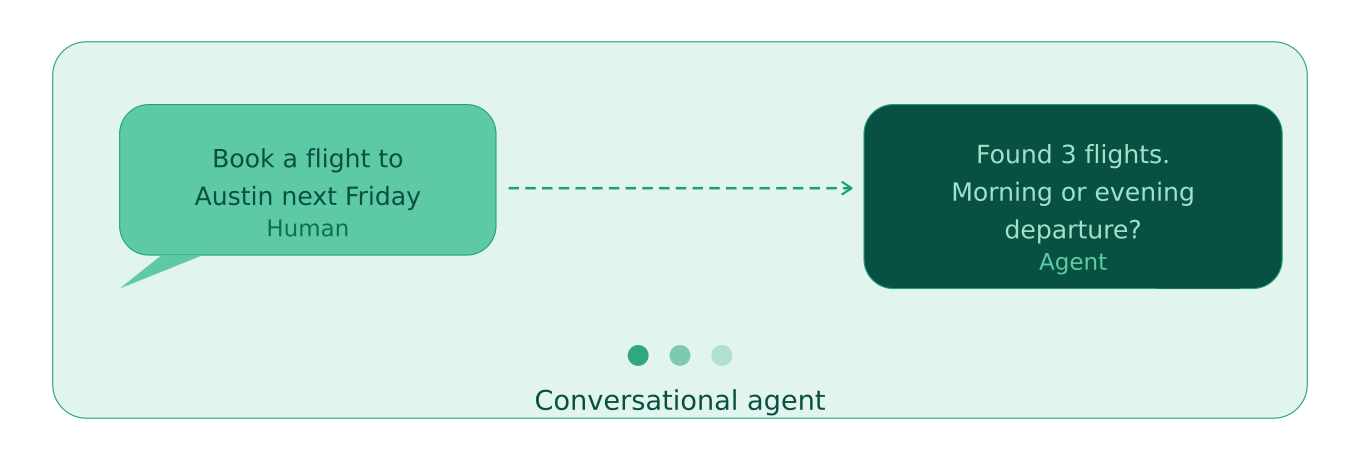
Conversational agents are the ones most people picture: a human types something, the agent reasons, calls tools, asks follow-up questions, and gets something done. They're interactive, multi-turn, and can live for the length of a conversation or much longer. Think of them as a knowledgeable colleague you can message — they stay in the loop, handle interruptions, and wait for you to respond before moving on.
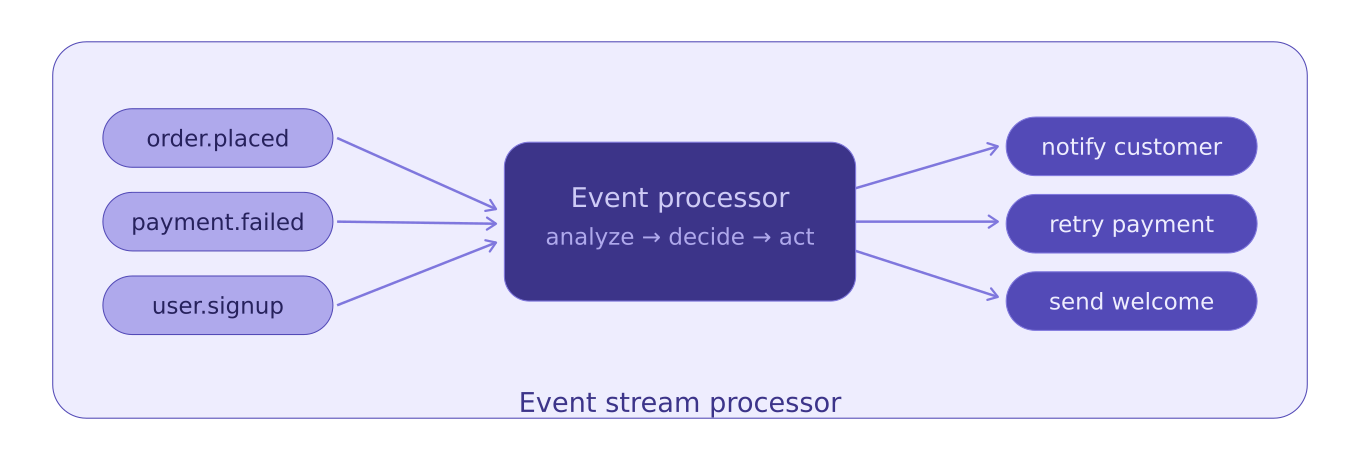
Event stream processors are agents that react to things happening in the world rather than waiting to be asked. A new order comes in, a sensor fires, a Slack message lands — and the agent wakes up, analyzes the situation, and takes action. These are less about conversation and more about detection and response. The analogy: a security camera with judgment, not just a recording.
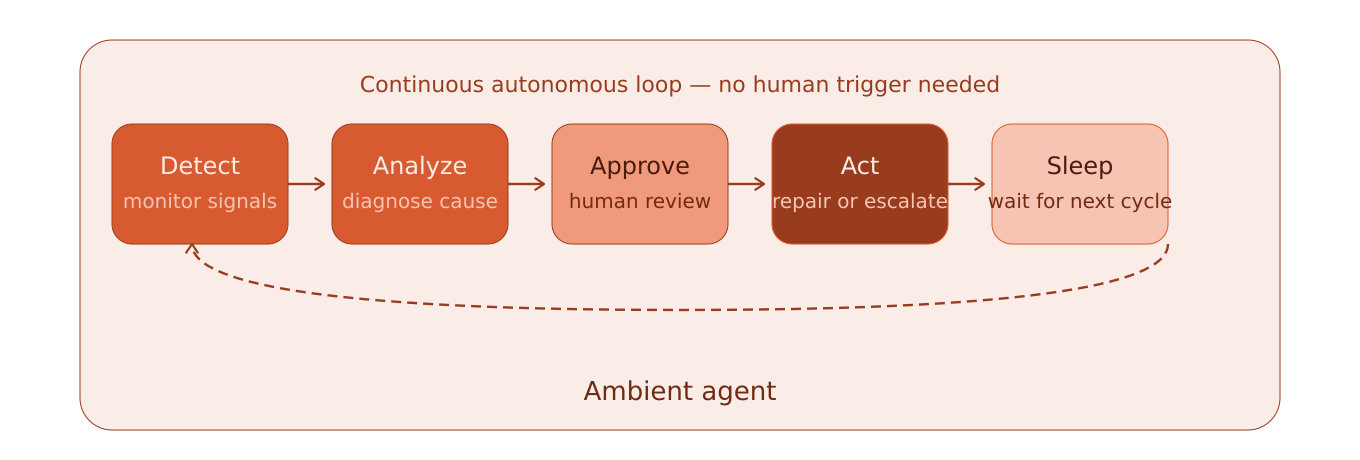
Ambient agents operate proactively and continuously, often without a human trigger at all. They're monitoring for problems, detecting anomalies, and acting autonomously when they're confident enough — and waiting for approval when they're not. Think of them as the responsible shift supervisor who handles routine issues independently but escalates the weird ones.
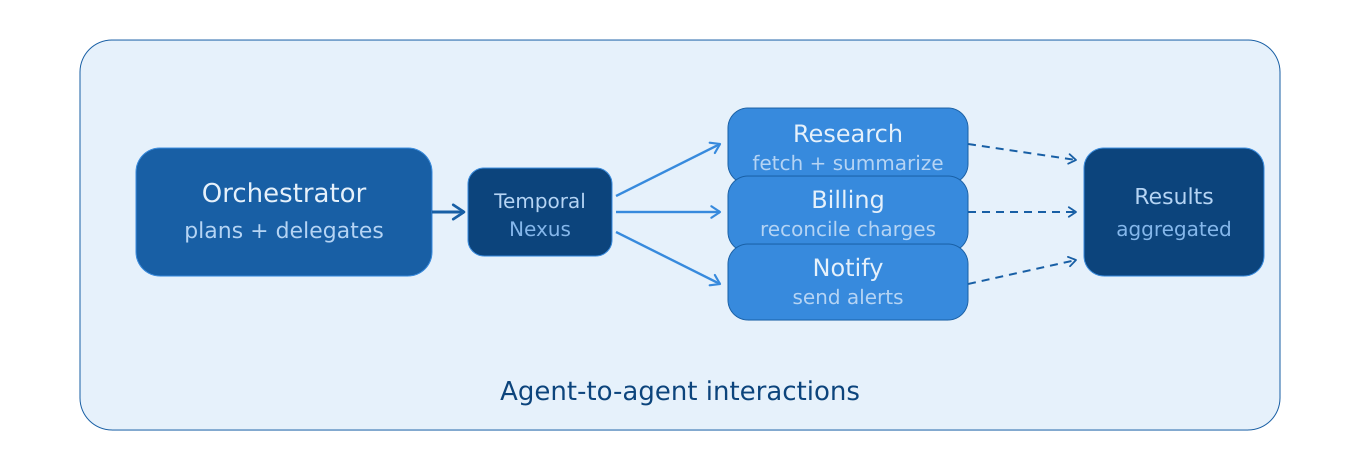
Agent-to-agent interactions are what emerge when the above get complicated: one agent delegates to another, a routing agent hands off to a specialist, a planner spawns executors. This is where the real power lives — and also where the real chaos begins if you don't have good orchestration underneath.
Each of these shapes puts different pressures on your architecture. Conversational agents need to hold state across a long, unpredictable interaction. Event stream processors need to fan out and retry reliably. Ambient agents need to sleep for hours or days without losing their place. Multi-agent systems need coordination primitives that don't turn into distributed deadlocks.
One framework to make all of these agent types simple to build? Temporal Workflows are exactly that. Temporal gives your AI applications the key things you will need: guardrails, human-machine interaction, versionability, durability, cost management, visibility and auditability, and parallel processing — all useful for deep context gathering and preparation.
The leadership layer: Guardrails, not just guardbumpers#
When you deploy agents into production, you're not just shipping software. You're delegating authority. The agent can read your data, direct your business flows, call your APIs, modify your records, and send communications on your behalf. That's a fundamentally different level of trust than a CRUD endpoint.
Executives and architects asking "how do we govern this?" are asking the right question. The answers usually cluster around three concerns.
Guardrails: How do we make sure agents don't do things we didn't intend? This isn't just prompt engineering — it's structural. In Temporal, you can build approval gates directly into the workflow. The agent proposes an action, the workflow pauses, a human reviews it via Signal, and execution resumes. The pause isn't a hack or a workaround — it's a first-class primitive. You can require human approval for high-stakes actions, auto-approve for high-confidence routine ones, and set timeouts so things don't hang forever if nobody responds. You can build guardrails with code to match your business rules, or use LLM-as-judge with context goals to let the AI keep itself on track.
Conflicting agents: What happens when two agents operate on the same data? Left unchecked, this is a recipe for race conditions, double-executions, and mutually inconsistent state — all the classic nightmares of distributed systems, now with AI on top. Temporal's workflow model provides natural isolation: each workflow instance has its own execution context, and you can use workflow IDs, unique keys, and built-in idempotency to ensure only one agent is acting on a given entity at a time.
Data security: Agents operate on sensitive data — customer records, financial transactions, personal information. Temporal gives you namespace and process (workflow) isolation, encryption, and a complete audit trail of every input, every decision, every tool call, and every output. Not as an afterthought — as a natural artifact of how Temporal stores state. Your compliance team will appreciate that you can answer "what did the agent do and why?" for any execution, any time. For additional execution security, Temporal can orchestrate tool and agent execution in sandboxes like Docker, Daytona, or E2B.
These aren't nice-to-haves. For any agent operating in a regulated industry or handling customer data, they're the price of admission.
Coordinating humans, not just machines#
I'm passionate about making it easy to scale out an agent fleet — building many agents for many different business purposes. This often means that agents don't get built by one person in one repository. In any real organization doing agentic AI at scale, you have multiple teams building agents: a team building the customer support agent, another building the billing reconciliation agent, another building the data enrichment agent. These agents may share tools, share data, and eventually need to share execution context.
Temporal makes it easy to reuse agentic code. The first Temporal agent sample I worked on was built to be reusable, with dynamic context, goals, and tools.
Runtime orchestration is a separate challenge. Without coordination, what you get is an agent zoo — a collection of creatures that are individually impressive and collectively chaotic. So what is the best way to coordinate agents without compromising access?
For coordinating running agent interaction, Temporal Nexus is a great answer. Nexus lets teams expose their Temporal workflows and activities as versioned, discoverable endpoints that other teams can call across namespace boundaries. It's a gateway for agentic services — similar to how a microservices platform gives teams a contract for calling each other's APIs, but built for the durable execution model.
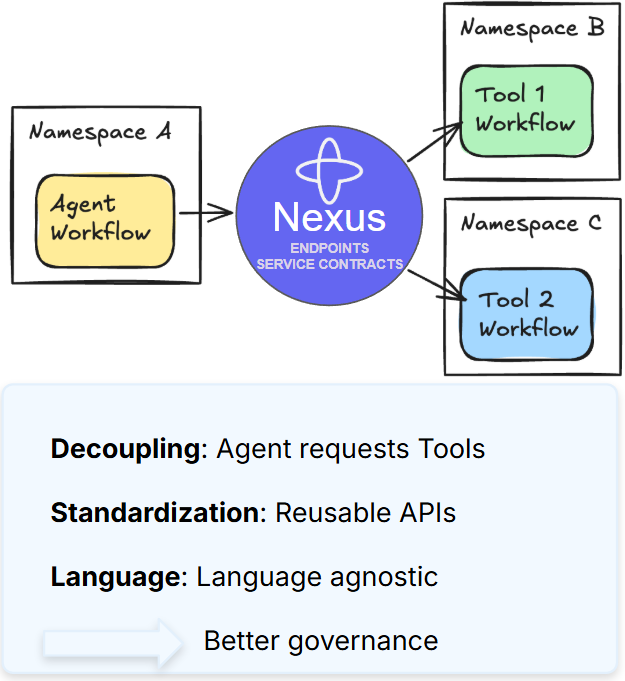
Practically, this means teams can register their agents as callable services with explicit inputs, outputs, and SLAs. A composing workflow can call into another team's agent without knowing its internal implementation. Cross-team agent interactions become first-class, versioned, observable calls rather than informal HTTP calls or shared queue hacks. And the connection is secure from each endpoint, so services can control who can call them and what information they expose.
Think of it like the difference between every team running their own fax machine (agents calling each other ad hoc) versus having a central switchboard where everyone has a published extension. Nexus is the switchboard. You know who's available, what they accept, and what they promise to return.
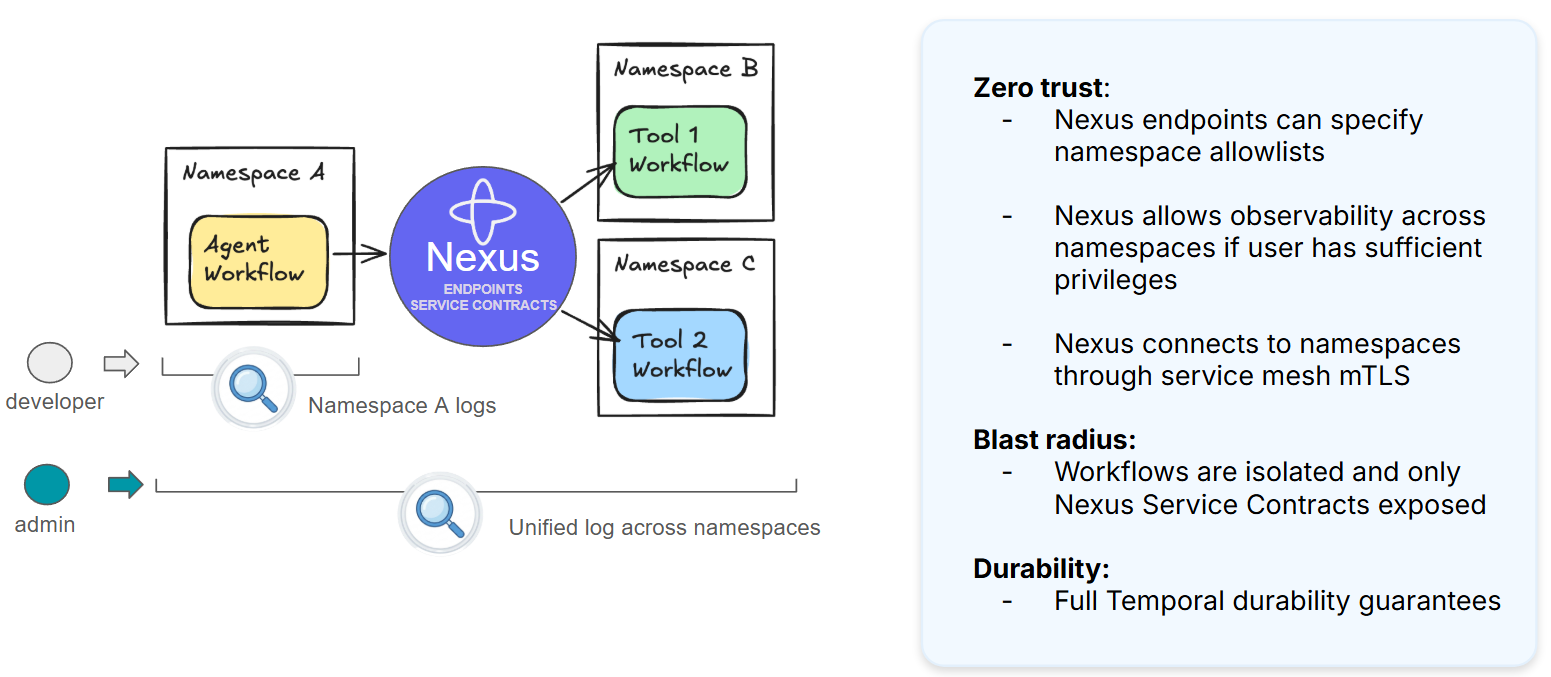
This matters enormously when you're scaling from two agents to twenty to two hundred. Without this kind of registration and contract layer, the coordination cost grows faster than the agent count.
Change management: Versioning for the AI era#
Here's a common scenario with long-running agents: your billing agent has been running in production for three months. It has live workflow instances that are mid-execution — some of them have been waiting for human approval for a week. You just realized the context prep needs to load more data to handle an edge case. How do you deploy that change without corrupting the in-flight executions?
This is the change management problem, and it can be harder with agents than with traditional software because agent workflows are often long-lived and stateful.
The good news: Temporal has solved this problem for a long time, as it was built to manage long-running processes and handle change gracefully. Temporal's Workflow Versioning APIs are built precisely for this need. Using workflow.patched() (or GetVersion() in Go/Java), you can introduce new logic branches that apply to new workflow instances while existing ones continue running the old code path. It's a controlled migration, not a big-bang cutover — like upgrading the runway while the planes are still landing.
To safely roll out a whole new version of agents without disrupting running processes and A/B test agent versions, you can use Temporal Worker Versioning to manage sets of versions.
For agentic systems, this is not a theoretical concern. Agent prompts change. Tool definitions evolve. New approval policies get added mid-flight. You want to roll out new capabilities while keeping existing agentic flows running as they started. Versioning gives you the ability to ship these changes confidently, with rollback paths and the ability to reason about which instances are on which version of your logic.
The operational realities: Cost, retries, and long-running agents#
Reliability and cost management go hand in hand with agentic systems.
LLM costs spiral. Agents that retry aggressively, re-process large contexts unnecessarily, or spawn sub-agents without bounds can generate surprisingly large API bills. Temporal gives you control over retry policies at the activity level — you can cap retries, implement exponential backoff, and set schedule-to-close timeouts that bound total execution time and therefore total cost. Temporal keeps intermediate results so that a failure mid-process doesn't require re-running expensive LLM calls from the beginning.
Failures happen constantly. APIs go down. LLMs return malformed JSON. External systems time out. In a traditional system, you write retry logic everywhere and hope you covered all the cases. In Temporal, retry is the default — every Activity call automatically retries until it succeeds or hits your configured limit. This isn't just convenient; it's architecturally transformative. Your agent code doesn't need to handle transient failure. Temporal handles it for you.
Agents need to run for a long time. A conversational agent might span a multi-day back-and-forth with a user. An ambient agent might monitor a system for weeks before acting. An approval workflow might wait hours for a human to respond. Traditional request/response infrastructure isn't built for this. Temporal workflows can run for days, months, or years without losing state. They sleep efficiently, resume on demand, and survive server restarts, deployments, and crashes without missing a beat. The agent doesn't even know the server restarted.
Visibility: Knowing what your agents actually did#
Here's a question every leader over AI eventually asks: "What exactly did that agent do?"
This should be simple. Unfortunately, it often isn't. The chain of reasoning, the tool calls made, the intermediate states, the LLM prompts sent and responses received — these often live in logs scattered across multiple services, or nowhere at all.
In Temporal, the full workflow history is a first-class artifact. Every Signal received, every Activity executed, every decision branch taken: it's all recorded, queryable, and replayable. This gives you:
- Debugging: When something goes wrong, you can see exactly where and why, not just that it failed.
- Auditing: For compliance or customer inquiries, you can reconstruct what the agent did and when.
- Analytics: Workflow history is the raw material for understanding agent performance over time — where do agents get stuck? Which tools fail most often? Where do humans consistently reject agent proposals?
- Reset-ability: At development time, you can reset your agent flows to try different prompts or steps mid-flow, without re-executing earlier steps that already succeeded — saving time and cost.
Temporal's UI surfaces this visually. You don't have to grep logs to understand what your agent fleet is doing. You can see it.
Context preparation: The data work before the thinking work#
One critical part of agentic architecture I'm excited to see surfacing is context preparation: the work of assembling the right information before handing it to an LLM. Get this wrong and you're burning tokens on irrelevant context, hitting context window limits, or sending the agent on a reasoning path that was never going to succeed.
Temporal provides excellent capabilities for context prep. The workflow can fetch data from multiple systems in parallel, filter and format it, handle failures in any one of those fetches gracefully, and then pass the assembled context to the LLM as a well-structured Activity input. This transforms context preparation from an afterthought into a deliberate, durable, observable step in the overall agent flow.
Think of it like the prep work before surgery: the success of the procedure depends enormously on what happens before the surgeon walks in. Temporal lets you treat context prep with the rigor it deserves.
Putting it together#
Here's what a well-orchestrated agentic system looks like with Temporal underneath:
- Conversational agents run as long-lived Workflows, receiving user input via Signals, pausing for approval when needed, resuming when humans respond.
- Event stream processors trigger Workflows on incoming events, fan out to sub-agents as Activities, and retry transient failures automatically.
- Ambient agents sleep in Workflows for days at a time, wake on a schedule or trigger, run their DAPER cycle (Detect, Analyze, Plan, Execute, Report), and wait for human approval when confidence is below threshold.
- Agent-to-agent interactions and tool calls happen through Nexus calls or child Workflows, with clean contracts, versioned interfaces, and full observability across team boundaries.
All of these agents benefit from the capabilities a Temporal-based architecture provides: visibility, scalability, auditability, durability to run as long as needed, and human interaction primitives that make human-in-the-loop easy.
Leaders and architects get guardrails, audit trails, conflict prevention, and cost controls — not as separate add-ons, but as natural outputs of the orchestration layer.
The reason Temporal is such a natural fit for agents isn't just that it solves the hard problems of distributed systems (though it does). It's that the mental model maps directly onto how you think about agent behavior: long-running processes, external interactions, human checkpoints, dynamic decisions, and the need to survive the chaos of the real world.
Ready to build agentic systems that actually hold up?
- Check out our Temporal AI Cookbook with helpful solutions.
- Explore the Temporal Agentic AI Framework on GitHub.
- Take our Building MCP Tools with Temporal course.
- Watch our Agent Orchestration Webinar.
- Join the conversation in the Temporal Community Slack in #topic-ai.
- Talk to an expert about your specific architecture.
- Sign up for Temporal Cloud and get $150 in free credits.